
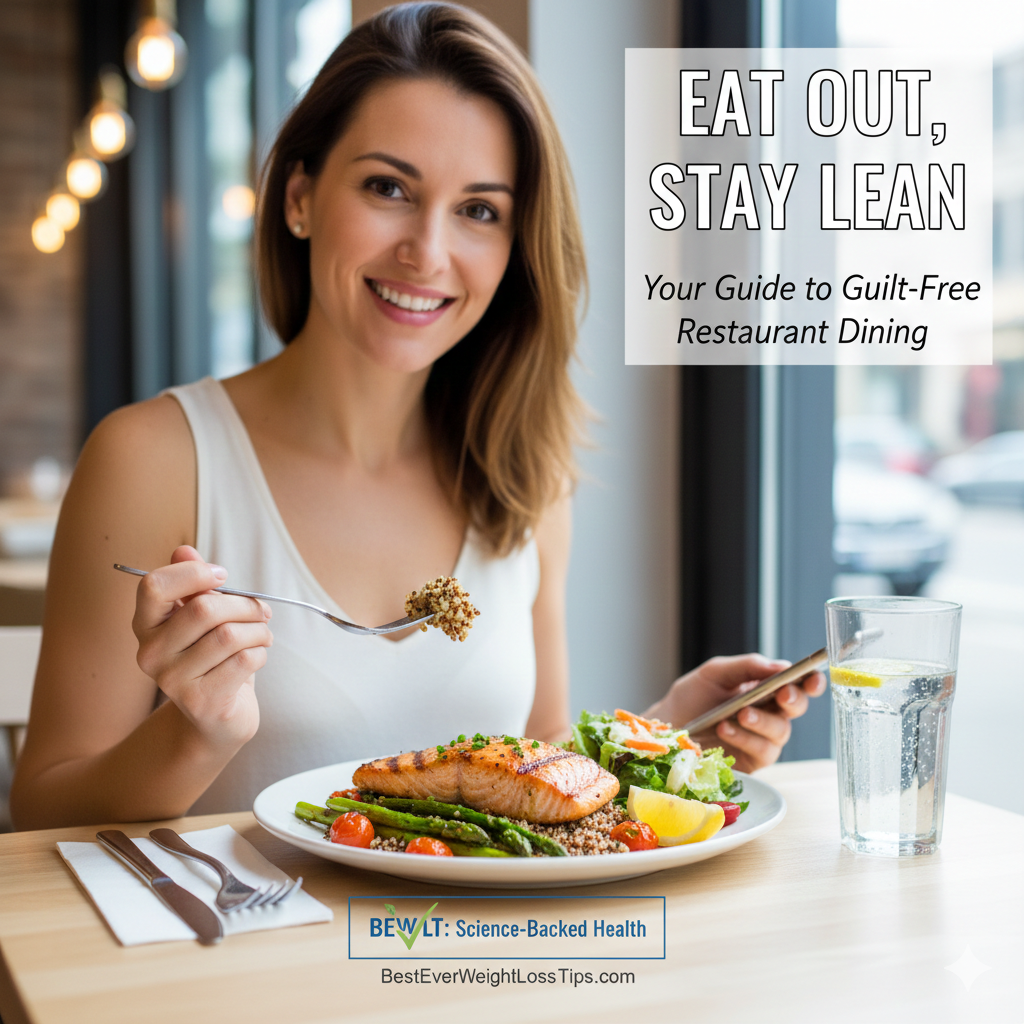
The complete guide to navigating restaurants, events, holidays and nights out — without losing your social life or your results
besteverweightlosstips.com • 14 min read • Weight Loss Lifestyle
You’re doing everything right. You’re tracking your food, hitting your protein targets, staying consistent all week. Then Friday arrives and others step in: your friends book a restaurant, your partner suggests a takeaway, your mum puts a three-course roast on the table. Suddenly, the diet that was going so well feels like it’s standing directly between you and the life you actually want to live.
Want to know the good news, though? Socialising and weight loss are not mutually exclusive.
The problem isn’t restaurants, events, or celebrations. The problem is the all-or-nothing thinking that turns a single dinner out into a reason to abandon the entire week, or the belief that lasting weight loss requires living in a kind of self-imposed dietary isolation.
The people who successfully maintain their weight long-term are not socially isolating; they have learned how to navigate social eating with skill, not willpower. They use strategies, not suffering, and those strategies can be learned.
This guide covers everything: how to approach restaurant menus, how to handle social pressure, what to do before, during and after a night out, specific tips for different settings, and – critically – how to shift your mindset from restriction to flexibility without losing your results. By the end, you’ll be able to go to any dinner, any party, any holiday without dreading it or feeling guilty afterwards.
The Mindset Shift That Changes Everything
Before any practical strategy, the most important thing to understand is this: weight loss happens over weeks and months, not individual meals. A single restaurant dinner, even a genuinely indulgent one, does not make or break your progress. What matters is the pattern across time.
The maths are reassuring. If you’re in a 500-calorie daily deficit five days a week and eat at maintenance (or even slightly above) two days a week, you will still lose weight. Consistently. Over time. The science of energy balance doesn’t suddenly stop working because you had pasta and a glass of wine.
What derails people is the psychological spiral that follows a social meal they’ve decided was “off plan”: the guilt, the shame, the “I’ve already ruined it, so I might as well” thinking that turns one dinner into a week of abandoning everything. That spiral – not the dinner – is the real threat to progress.
THE GOLDEN RULE
Progress is not destroyed by a single meal. It is built by hundreds of small, consistent choices … and preserved by how quickly you return to those choices after a break.
The goal, then, is not perfection. It’s flexibility with intention. Going out with a plan and making smart choices where possible. Genuinely enjoying yourself when indulgence is worth it. And returning to your normal pattern the very next meal — without drama, without punishment, without a week of “I’ll restart Monday.”
Why Rigid Restriction Always Backfires
Diets that allow zero flexibility in social situations don’t just make life miserable; they actually make weight loss harder. Chronic restriction elevates cortisol (the stress hormone), which promotes fat storage and increases cravings. Social isolation from food-related events increases psychological distress. And the inevitable moments when restriction breaks – which they always do – tend to produce much larger overconsumption than would have occurred with moderate flexibility built in from the start.
Research consistently shows that flexible dietary restraint – the approach that includes planned indulgences and strategies for social eating – produces better long-term weight loss outcomes than rigid restriction. Not just psychologically, but physiologically. Sustainability always beats short-term intensity.
Before You Go: Preparation Is Your Secret Weapon
The most successful social eaters don’t white-knuckle their way through a menu – they’ve thought ahead. A little preparation before any social occasion dramatically reduces the decisions you need to make in the moment, when food smells amazing, everyone around you is ordering freely, and your willpower is at its lowest point.
1. Check the Menu in Advance
Almost every restaurant posts their menu online. Spend two minutes the night before deciding what you’ll order. When you already have a decision made, you’re insulated from the social pressure of the moment – the ambience of the room, the influence of what others order, the sensory overload of being hungry in a restaurant that smells incredible. You arrive knowing your choice and you make it with confidence. Don’t even look at the menu – be the first to order. Done.
If calorie counts are available (many chain restaurants publish them), use them as a guide, not an obsession. If they’re not available, focus on identifying dishes built around lean proteins and vegetables, and be aware that sauces, dressings, and cooking methods can add several hundred calories invisibly.
If you’re stuck, order a vegetable dish – it will more than likely be the least calorific choice.
2. Eat Something Before You Leave
Arriving at a restaurant genuinely hungry is one of the most guaranteed ways to overeat: judgment goes out the window, eating fast accelerates, and every item on the menu looks irresistible. Have a small protein-rich snack 60–90 minutes before you leave – a handful of nuts, a boiled egg, some Greek yoghurt, a protein shake. That one power move takes the edge off your hunger without ruining your appetite, and gives you back the decision-making clarity you need. For extra oomph, drink a glass of water on arrival to minimise your chance of overeating.
3. Bank Some Calories Earlier in the Day
If you know dinner tonight will be generous, plan ahead – make lunch lighter and higher in protein. This isn’t deprivation – it’s simple calorie accounting. Shift your daily budget toward the meal you’re most looking forward to. Eat a large salad with some chicken or tofu for lunch, skip the afternoon snack, and you’ve given yourself several hundred extra calories to enjoy at dinner without going over your weekly average.
Absolutely do not skip breakfast or go all day without eating as a “saving up” strategy. Extreme pre-event restriction certainly leads to extreme overeating. You want to arrive at dinner feeling comfortable, not ravenous.
4. Set a Loose Intention, Not a Rule
There’s a difference between a rule (“I will not eat carbs”) and an intention (“I’ll prioritise protein and vegetables and enjoy one thing I really want”). Rules feel like restraints that beg to be broken; intentions feel like guidance you’re choosing. Set a loose intention for the evening – not as a restriction, but as a compass.
At the Restaurant: Smart Choices Without the Suffering
You don’t need to order a plain salad and sparkling water while everyone else eats. You need to know how to navigate a menu so you can enjoy a genuinely satisfying meal that also supports your goals. Here’s how.
The ‘Protein First’ Ordering Strategy
When scanning a menu, start with the protein — not the carbohydrate. Ask yourself: what’s the best lean protein option here? Then build your order around it. Grilled fish, roasted chicken, lean beef, legume-based dishes, eggs, prawns — most menus have at least one solid option. Once you’ve anchored to the protein, everything else flows from there.
Sauces, Dressings and Sides — The Hidden Calorie Hubs
Restaurant cooking uses far more butter, oil, cream, and salt than home cooking. The same grilled chicken breast that’s 200 calories at home can easily be 450 calories at a restaurant once it’s been finished in the pan with butter and served with a cream sauce. A side salad with dressing can contain 300 calories. A Caesar salad can hit 700.
Simple adjustments make a significant difference: ask for sauces and dressings on the side (you’ll use a fraction of what they’d pour), request grilled or baked instead of fried where possible, and ask for extra vegetables instead of chips or fries as your side. Most restaurants are willing to accommodate — you just have to ask.
The Bread Basket
The bread basket is a pre-meal calorie addition that requires zero conscious engagement – you eat it simply because it’s there. A few slices of bread with butter can easily add 300–500 calories before your actual meal arrives. You have sensible options: ask the server not to bring it (entirely socially acceptable), decide in advance that you’ll have one piece and genuinely enjoy it, then move it out of reach, or ignore it. Bread eating is usually mindless. Be active and engaged in conversation instead.
How to Approach Starters and Shared Dishes
Shared entrees and tapas-style dining can actually be weight-loss friendly if you’re deliberate. You eat smaller amounts of more things, eating speed slows down (you’re waiting for dishes to be passed), and the social engagement of sharing food is genuinely enjoyable. The challenge is tracking portions when food is communal. A useful heuristic: take one serving and wait. If you’re still hungry after the main course, reconsider. Often you won’t be.
Eating Speed – The Underrated Tool
Fullness hormones take around 20 minutes to register in your brain after your stomach has received food. Eating slowly – putting your fork down between bites, actually chewing, and engaging in conversation between mouthfuls – gives your satiety system time to catch up. At a social dinner, this is completely natural: the conversation and the company are the point, not the speed of consumption. Let the social setting work for your eating, not against it. Eating slow is a practised, elegant art – try it.
Dessert — The Intelligent Approach
You do not have to order dessert. You do not have to refuse it either. The middle path — sharing a dessert with someone else at the table – is genuinely one of the smartest moves in social dining. You participate in the ritual, you get to enjoy the best bites (the first few are always the most satisfying), and you consume a fraction of the calories. If nothing on the dessert menu genuinely excites you, order a coffee or herbal tea instead. Fake enthusiasm for mediocre cheesecake serves nobody.
Quick Cuisine Guide: Best Bets at Common Restaurant Types
Different cuisines present different challenges and opportunities. Here’s a fast reference guide:
| Cuisine | Smarter Choices | Watch Out For |
| Italian | Tomato-based pastas, grilled fish or chicken, minestrone, bruschetta (one piece), salads | Cream sauces (carbonara, alfredo), large pasta portions, tiramisu, multiple bread courses |
| Asian / Thai | Stir-fries with lean protein, sashimi, steamed dumplings, tom yum soup, veggie-forward curries | Fried rice, pad thai (hidden sugar & fat), spring rolls, large noodle dishes, coconut-heavy curries |
| Indian | Tandoori dishes, dal, chicken tikka, raita, saag, roti (one) | Butter chicken, biryani with naan, samosas, creamy paneer dishes, multiple roti/naan |
| Mexican | Grilled fajitas (chicken/prawn), beans, salsa, corn tortillas, guacamole (small portion) | Sour cream, cheese-heavy nachos, chimichangas, large burritos, fried tortilla chips |
| Burger/Pub | Protein-style or lettuce wrap, side salad instead of chips, grilled not fried | Double patties with sauces, chips (300–500 kcal), creamy coleslaw, milkshakes |
| Japanese | Sashimi, edamame, miso soup, salmon or tuna rolls, tofu dishes | Tempura, large ramen portions, tonkatsu, teriyaki sauces (high sugar), fried gyoza |
| Steakhouse | Lean cuts (sirloin, fillet), side vegetables, mushrooms, grilled fish options | Creamy sides (mash, mac & cheese), large portions, sauces, garlic bread |
Navigating Alcohol: An Honest, Non-Preachy Guide
Alcohol is part of social life for many people. This guide is not going to tell you to stop drinking – that’s your personal choice to make. What it will do is give you honest information about alcohol and weight loss so you can make informed decisions.
What Alcohol Actually Does to Fat Loss
Alcohol contains 7 calories per gram – almost double carbohydrates and protein (4 kcal/g each), and close to fat (9 kcal/g). Unlike the other macronutrients, alcohol provides no useful nutrition and cannot be stored – your body prioritises metabolising it above everything else. This means that while you’re processing alcohol, fat burning is essentially paused.
Beyond the direct calories, alcohol increases appetite (especially for salty, fatty foods), lowers inhibitions around food choices, and disrupts sleep, which itself elevates hunger hormones the next day. The total impact of a heavy night out is therefore considerably more than just the drink calories themselves.
Lower-Impact Drink Choices
If you’re going to drink and want to minimise the caloric impact:
| Drink | Approx. Calories | Notes |
| Dry white or red wine (120ml glass) | 80–100 kcal | Prefer drier varieties — less residual sugar |
| Spirits (30ml) + soda water or diet mixer | 65–80 kcal | Gin & soda, vodka lime & soda — excellent low-cal option |
| Light beer (330ml) | 80–110 kcal | Significantly lower than full-strength lager or craft beer |
| Champagne / Prosecco (120ml) | 80–90 kcal | Festive and lower in sugar than many wine styles |
| Standard lager / beer (500ml pint) | 180–240 kcal | Adds up quickly — two pints = one full meal’s worth of calories |
| Cocktails (Margarita, Pina Colada etc) | 250–450 kcal | Sugar-heavy mixers make these extremely calorie-dense — limit to one |
| Espresso Martini | 200–300 kcal | Coffee + vodka + sugar syrup + liqueur — a hidden calorie bomb |
| Creamy cocktails / liqueur drinks | 350–550 kcal | Treat these as desserts — because calorically, they are |
Key alcohol strategies:
- drink water alongside every alcoholic drink (it slows consumption, keeps you hydrated, and helps you feel fuller);
- eat before drinking (drinking on an empty stomach dramatically accelerates intoxication and appetite dysregulation);
- and set a drink limit in advance so you’re making that decision from a clear head, not at round three of the night.
ALCOHOL HONESTY NOTE
Moderate drinking (1–2 drinks at social events) is compatible with weight loss if the rest of your week is consistent. Regular heavy drinking is not — both for the calories and the downstream effects on sleep, hunger, and decision-making.
Handling Social Pressure Without Being Awkward About It
One of the most underappreciated challenges of eating out on a diet isn’t the food — it’s other people. The colleague who insists you try a slice of birthday cake. The friend who says “you’re being too strict, just have some.” The family member who’s offended you’re not having seconds. Social pressure around food is real, pervasive, and genuinely difficult to navigate gracefully.
You Don’t Owe Anyone an Explanation
The most powerful tool in your arsenal is brevity. “No thank you” is a complete sentence. “I’m good, thanks” requires no justification. Most food pressure dissolves the moment you decline cheerfully and confidently, without apologising or over-explaining. The more you justify — “I’m trying to be healthy” / “I’ve been really good this week” — the more you invite discussion, concern, and further pushing.
If someone persists, a comfortable deflection: “I’m savouring what I’ve got, honestly – it’s great.” This sidesteps the whole conversation without conflict. People generally want you to enjoy yourself; telling them you are typically ends the exchange immediately.
Selective Disclosure
Whether or not to tell people you’re watching your weight is entirely your call. There are advantages both ways. Telling close friends or family can create a support system that actively helps rather than pressures. On the other hand, announcing a diet publicly can attract unsolicited opinions, create awkwardness around every meal you share with those people, and add a layer of social accountability that some people find motivating and others find suffocating.
A middle path: tell one or two trusted people whose support you. Keep it private from everyone else. You don’t need permission or validation from your social circle to make healthy choices.
When You’re the Host
Being the person organising the dinner or event is actually a significant advantage. You get to choose the restaurant (pick one with options you know work for you), suggest a cuisine you’re comfortable navigating, or structure a dinner at home where you control the food completely. Nobody said healthy eaters can’t also be excellent hosts – in fact, some of the most celebrated dinner party food is naturally nutritious and spectacularly delicious.
Specific Situations: Tailored Strategies for Every Setting
Work Events and Networking Functions
Canape-and-drinks events are notoriously easy to overeat at — you’re standing up, chatting, and mindlessly picking at trays of food as they pass. The calorie accumulation can be enormous without a single sit-down meal. Strategies: eat a proper meal beforehand so you’re not relying on canapes for nutrition; stay with sparkling water or a single drink and keep something in your hand (even a glass of water) to make it natural to decline passing trays; position yourself away from the food table.
Weddings and Celebrations
Wedding food is often served in courses with no menu choice, generous portions, and wine flowing freely. Accept that this is a celebration meal — one of perhaps 20 such meals per year — and treat it accordingly. Eat slowly, savour every course, drink moderately, dance (genuinely excellent calorie burn), and return to your normal pattern the following morning. One wedding is not a threat to your goals. Being so preoccupied with your diet that you can’t enjoy someone’s wedding day is a real loss.
If you have some control over what you eat (at a buffet or less formal setting): load up on proteins and vegetables first, be intentional about your one indulgence (the cake, the dessert, the cheese board — pick one that genuinely excites you), and skip the things you wouldn’t miss at home.
Holiday and Travel Eating
Holidays present a different challenge: an extended period of disrupted routine, unfamiliar food environments, and a cultural permission slip to “let loose.” The key insight is that moderation over an extended trip protects both your progress and your enjoyment far better than alternating between extreme restriction and uninhibited eating.
- Prioritise protein at every meal – it’s available everywhere in some form and keeps you full between tourist adventures
- Walk everywhere you can – sightseeing on foot is one of the best NEAT activities available and genuinely enjoyable
- Stay hydrated – dehydration is common during travel and is frequently confused with hunger
- Choose local whole-food cuisine over tourist-trap fast food – it’s generally more nutritious, more interesting, and often lighter
- Allow yourself two or three genuinely special meals per week of holiday (the renowned local dish, the special restaurant) rather than treating every single meal as a holiday meal
- Maintain your protein and water intake – these two variables protect muscle and regulate hunger regardless of everything else
Takeaway and Ordering In
Takeaway has become so frictionless — a few taps on an app and food arrives — that it can slip into the weekly routine far more heavily than you realise. And takeaway calories are notoriously difficult to estimate: a portion of butter chicken from a restaurant can range from 400 to 900 calories depending on how it was made.
Smarter takeaway habits: order from the menu, not from hunger (browsing apps while hungry always produces a larger order); choose grilled or baked over fried; ask for sauces on the side; skip the extras (sides, soft drinks, desserts) unless you’ve specifically budgeted for them; and consider whether you could replicate the dish at home with significantly fewer calories — it’s often faster and always cheaper.
Family Dinners and Home Entertaining
Family food culture runs deep, and “no thanks” can feel like rejection when someone has cooked for you. A middle path: take a smaller portion of everything, eat slowly, compliment the cooking genuinely, and decline seconds with warmth rather than apology. “This is genuinely delicious – I’m just savouring every bite” is both honest and kind. If you’re a regular guest somewhere, quietly becoming the person who brings a fantastic, healthy side dish is an elegant way to ensure there’s always something on the table that works for you.
The Morning After: Getting Back on Track Without Punishment
You went out. You enjoyed yourself. Maybe you ate more than planned or had more drinks than you intended. Now what?
The morning after is where your relationship with food and your body is most clearly revealed – and where most people make their biggest mistake. The wrong response: shame, restriction, skipping meals as “punishment,” or deciding the whole week is ruined and abandoning everything until Monday comes around again.
The right response: return to your normal routine with the very next meal. No drama. No punishment. No 24-hour fast to “compensate.” Just your regular breakfast, your regular protein target, your regular day. This single behaviour – the speed with which you return to your normal pattern after a deviation – is one of the strongest predictors of long-term weight loss success in the research literature.
THE MOST POWERFUL HABIT
The people who maintain weight loss long-term are not the ones who never deviate. They are the ones who get back to their normal eating within 24 hours of any deviation — automatically, without guilt, without fanfare.
Understanding Post-Meal Scale Fluctuation
If you weigh yourself the day after a big meal out and the scale shows 1–3kg more than yesterday, this is almost entirely water weight, not fat. A large restaurant meal — especially one with sodium, carbohydrates, or alcohol — causes the body to retain significant water. Each gram of glycogen (carbohydrate stored in muscle) is stored with 3–4 grams of water. One single restaurant dinner physically cannot deposit 2kg of new fat tissue on your body.
The bloating and scale weight from a big meal typically resolves within 24–72 hours as water balance normalises and digestion completes. If you know this in advance, you can step on the scale the morning after a restaurant without the psychological spiral that derails so many people’s progress.
Your Complete Social Eating Toolkit: 15 Strategies That Actually Work
We’ve compiled the best strategies that work in the real world, tested by real people living real social lives while losing and maintaining weight:
- Before the event: check the menu online and decide your order in advance: This removes in-the-moment decision fatigue and the influence of social cues.
- Eat a protein-rich snack 60–90 minutes before going out: Prevents arriving ravenous, which is the fastest way to overeat.
- Bank calories earlier in the day – but don’t skip meals: Shift your daily budget toward the meal that matters, without triggering rebound hunger.
- Request sauces and dressings on the side – always: You’ll use 20–30% of what they’d pour, saving 100–300 calories effortlessly.
- Order first when you can: Ordering before hearing what others choose protects your decision from social influence.
- Use the ‘protein anchor’ strategy: Identify the best protein option first, then build the rest of your order around it.
- Ask for the swap without apology: Substitute chips for salad or extra vegetables – most restaurants will do that.
- Share dessert rather than order your own: Participate in the social ritual, get the best bites, consume far fewer calories.
- Water between every alcoholic drink: Slows consumption, maintains hydration, and naturally reduces total alcohol intake.
- Eat slowly – use the conversation: Put your fork down between bites. Let the social setting work with your satiety system.
- Decline with confidence and warmth, not apology: “I’m great, thank you” ends most food-pressure conversations immediately.
- Focus on what you’re enjoying, not what you’re avoiding: Attention on pleasure rather than restriction reduces the psychological cost of choosing well.
- Give yourself a non-food reward for the evening: The goal is connection, laughter, and experience, and those don’t require a specific food choice.
- Return to normal at your very next meal: The most powerful recovery tool. No guilt, no punishment, just your usual routine.
- Zoom out to the week – not the meal: Weight loss is a weekly and monthly average – one well-prepared dinner won’t break it.
Making Peace With Food, Social Life and Your Goals
The deepest truth in all of this is that the relationship between food and life is not adversarial. Food is connection. It’s culture. It’s pleasure. It’s how we celebrate, mourn, welcome, and belong. A healthy relationship with weight loss is one that honours that truth rather than one that requires you to step outside of your life in order to achieve your goals.
The most sustainable weight loss journeys are not defined by their strictest moments. They’re defined by how naturally and gracefully the person navigates the full spectrum of life – the home-cooked meals and the dinner parties, the salads and the birthday cakes, the tracked days and the listen-to-your-body days. The goal is not a perfect diet – it is a life in which you feel good in your body and free in your choices.
You can go to the restaurant. You can clink glasses at the party. You can say yes to your grandmother’s cooking. And you can still reach your goals. Not despite your social life, but alongside it, with a little skill, a lot of grace and planning ahead.
1 thought on “How to Eat Out and Socialise Without Ruining Your Progress”