
The science of energy balance — and why no diet can override it
besteverweightlosstips.com • 13 min read • Weight Loss Science
Every year, a new diet promises to be the one that finally cracks the code. Go low-carb. Cut fat. Eat only in an eight-hour window. Never eat after 6pm. Drink this shake. Avoid that food group. The weight loss industry generates billions of dollars annually by convincing people that the key to their body lies in some newly discovered trick, ancient superfood, or proprietary formula.
Yet underneath all of it – every trend, every protocol, every “revolutionary” approach – sits one principle that has never once been disproved in the history of nutrition science: energy balance. Energy in versus energy out. The fundamental physics of your body weight.
This isn’t a new idea. It isn’t exciting or photogenic or easy to sell on Instagram yet it is, without qualification, the most reliable predictor of whether you will lose, gain, or maintain your body weight. Every diet that has ever worked has done so by creating an energy deficit. Every diet that has ever failed has done so by failing to maintain one.
This article explains the science clearly, busts the myths that cloud it, and gives you a practical, non-obsessive framework to actually apply it. By the end, you’ll understand your body’s energy system more deeply than most people ever do — and that knowledge is the most powerful weight loss tool you can have.
The First Law of Thermodynamics — Applied to You
The first law of thermodynamics states that energy cannot be created or destroyed — only converted from one form to another. Your body is a biological machine governed by this same physical law. The energy you consume from food (measured in kilocalories, universally called “calories”) must go somewhere. It is either:
- Used to fuel your body’s basic functions (breathing, heart rate, organ function, cell repair)
- Used to fuel your physical activity and movement
- Used to process and digest the food you eat
- Stored in your body — primarily as body fat — for future use
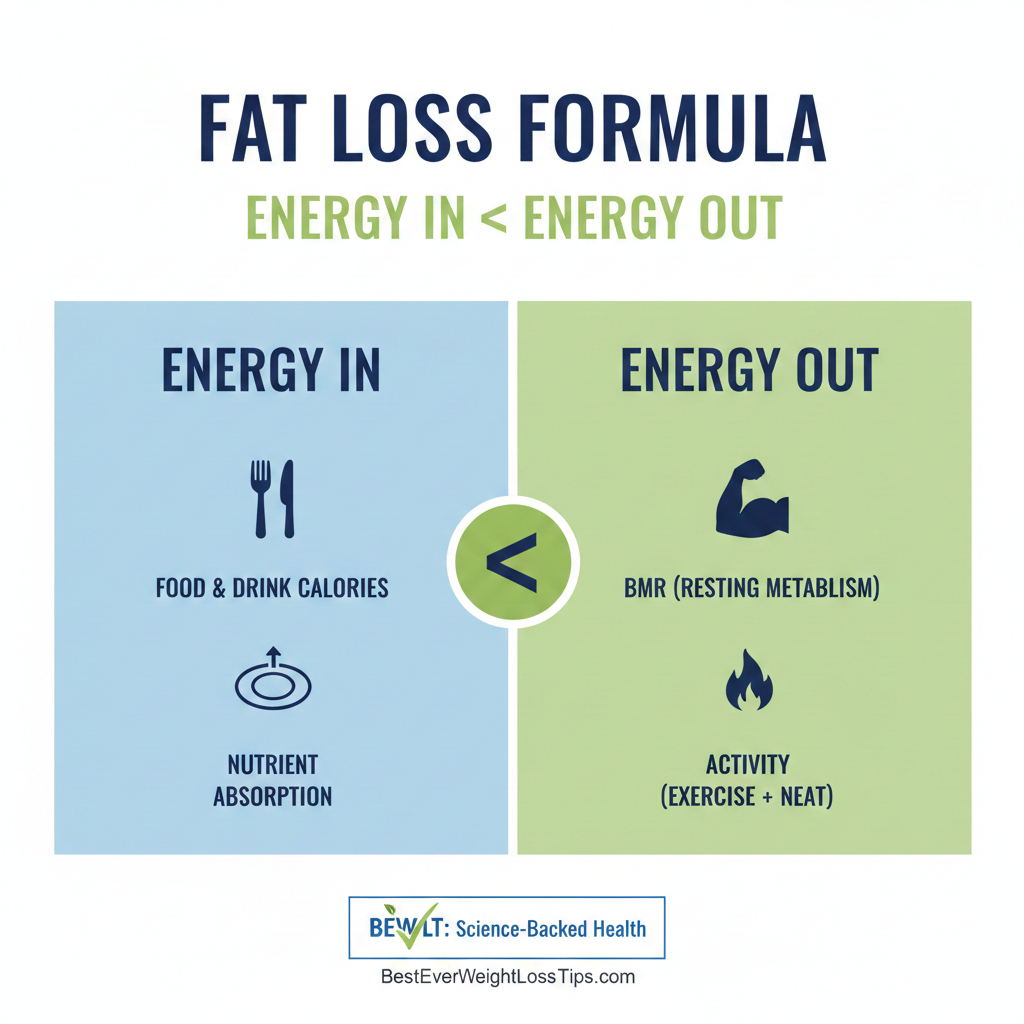
When you consistently consume more energy than you expend, the excess is stored — mostly as body fat. You gain weight. When you consistently consume less energy than you expend, your body draws on its stored energy to make up the difference. You lose weight. When input and output are equal, weight stays stable.
This is not a theory. It is not controversial among scientists. It is the foundational operating principle of human metabolism, supported by over a century of metabolic research across millions of people. No hormone, no jab, no food type, no eating window, and no supplement overrides it — though all of these things can influence it, which is where the nuance lives.
THE CORE EQUATION
Weight Loss = Energy Expended > Energy Consumed (sustained over time).
This is the only equation that has never had an exception.
Understanding ‘Energy Out’: What You Actually Burn
“Energy out” (ie your total daily energy expenditure or TDEE) is not just the calories you burn at the gym. It’s a composite of four distinct components, and most people dramatically underestimate how complex the equation really is.
| Component | % of TDEE | Also Known As | What It Covers |
| Basal Metabolic Rate (BMR) | 60–70% | Resting metabolism | Energy to keep you alive: breathing, heartbeat, organ function, cell repair — everything that happens while you sleep |
| Thermic Effect of Activity (TEA) | 15–30% | Exercise calories | Calories burned during deliberate exercise — running, gym, sport, swimming |
| Non-Exercise Activity Thermogenesis (NEAT) | 10–15% | Lifestyle movement | Walking to your car, fidgeting, taking stairs, housework — surprisingly significant |
| Thermic Effect of Food (TEF) | 8–10% | Dietary thermogenesis | Energy your body uses to digest, absorb, and process the food you eat |
Notice that BMR dominates — it accounts for 60–70% of everything you burn, even on days you don’t move much. This is why crash diets that dramatically slash calories can actually reduce BMR over time (your body adapts to survive on less), and why protecting your metabolic rate through adequate protein intake and resistance exercise is so important.
Also notice NEAT — non-exercise activity thermogenesis. Research from the Mayo Clinic found that differences in NEAT between individuals could account for up to 2,000 calories per day — a staggering gap. Some people naturally fidget, gesture, and move throughout the day; others sit still. This largely invisible component of energy expenditure explains a great deal of why two people eating the same food can have very different weight outcomes.
KEY INSIGHT
Exercise typically accounts for only 15–30% of your total energy burn.
The biggest lever for energy output is your BMR, which is why building muscle,
eating enough protein, and staying generally active (NEAT) matters far more than any single gym session.
Understanding ‘Energy In’: More Than Just Counting Calories
“Energy in” refers to the total caloric content of everything you eat and drink. While the concept is simple — food contains energy, your body extracts it — the reality is more nuanced than a number on a nutrition label suggests.
Not All Calories Behave Identically
100 calories from white sugar and 100 calories from chicken breast both count as 100 calories in the energy balance equation. But they have very different effects on your hunger, hormones, and body composition:
- Protein has the highest thermic effect
Your body burns 20–30% of protein calories just to digest it. 100 calories of protein effectively delivers only 70–80 net calories. It also triggers the strongest satiety response and preserves muscle tissue during weight loss.
- Fibre-rich foods slow digestion
High-fibre foods — vegetables, legumes, whole grains — slow gastric emptying, moderate blood sugar response, and produce fullness hormones that persist for hours. The same calorie count feels very different in terms of hunger.
- Ultra-processed foods are engineered to override fullness
Hyper-palatable foods — combining fat, salt, sugar, and specific textures — are specifically designed to short-circuit satiety signals. They make it easy to consume far more energy than your body registers as “full.”
- Liquid calories don’t register fully
Drinks like juice, alcohol, smoothies, sugary coffees, all add significant calories without triggering the same fullness responses as solid food, making it easy to consume hundreds of extra calories without noticing.
None of this changes the fundamental equation — a calorie is still a unit of energy and energy balance still governs body weight. But the type of calories you eat profoundly influences how easy or difficult it is to stay within your energy budget, how much muscle you preserve, and how satisfied you feel day to day.
Why Every Successful Diet Works — And Why They Often Fail
One of the most clarifying insights in all of nutrition science argues thus: every diet that has ever produced lasting weight loss has done so by creating a calorie deficit. It’s not by some special metabolic magic unique to that approach – simply by causing people to consume less energy than they expend.
Let’s look at how the most popular diets actually create their deficits:
| Diet Approach | Why It Works (The Real Mechanism) | Why It Often Fails |
| Keto / Low-Carb | Eliminating carbs removes entire food categories, reducing overall options and often total calories. High protein and fat increases satiety. Glycogen depletion causes rapid initial water weight loss (motivating). | Highly restrictive — social situations, travel, and cravings make long-term adherence difficult. Water weight returns immediately if carbs are reintroduced. |
| Intermittent Fasting | Compressing the eating window naturally reduces total food intake for most people. Simpler rules reduce decision fatigue. | Some people compensate by eating more in the eating window. Hunger and social disruption challenge compliance. No inherent metabolic advantage over equivalent daily deficit. |
| Plant-Based / Vegan | Whole plant foods are low in calorie density and high in fibre — it’s genuinely hard to overconsume them. Eliminating animal products removes many calorie-dense foods. | Processed vegan foods are just as calorie-dense as conventional ones. Protein adequacy requires planning. Some people don’t enjoy the food. |
| Mediterranean Diet | Emphasises whole foods, healthy fats, lean protein, and vegetables. Naturally moderates calorie-dense processed foods. High palatability improves long-term adherence. | No explicit calorie guidance — some people simply shift to eating large amounts of ‘Mediterranean’ foods without a deficit. |
| Calorie Counting (CICO) | Direct, explicit management of energy balance. Works for anyone who can accurately track intake. | Calorie tracking is tedious, often inaccurate, and psychologically exhausting for many people long-term. Poor food quality is technically compliant but practically unsustainable. |
The conclusion is unavoidable: the best diet is the one that creates a sustainable calorie deficit for you specifically — given your food preferences, lifestyle, psychology, and social context. There is no universally superior approach beyond this.
Busting the Myths That Derail People
The energy balance principle is so well established that myths about it tend to emerge not from science, but from marketing, misunderstanding, and the very human desire for a simpler explanation. Let’s address the most damaging ones directly.
Myth 1: “Hormones override calories — you can’t lose weight if your hormones are wrong”
Hormones — particularly insulin, cortisol, leptin, and ghrelin — play a significant role in appetite, fat storage patterns, energy levels, and how your body responds to food. This is real and important. But hormones influence the energy balance equation rather than override it.
High cortisol from chronic stress increases cravings for calorie-dense food and may promote fat storage in the abdominal region — but it does so by increasing energy intake or altering where fat is deposited, not by conjuring new fat from nowhere. Insulin resistance makes weight loss harder by making calorie restriction feel more miserable — but weight loss still occurs when a deficit is maintained. Clinical studies of people with hypothyroidism, PCOS, and insulin resistance consistently show weight loss when a calorie deficit is achieved, even if the deficit must be deeper or the approach more carefully managed.
Myth 2: “Eating at night makes you fat”
Your body does not have a clock that converts food to fat at midnight. Calories consumed at 10pm are processed identically to calories consumed at 10am in terms of energy balance. What istrue is that late-night eating is often associated with mindless consumption of calorie-dense snacks while watching television — meaning the problem isn’t the timing, it’s the extra calories. The clock is innocent; the bag of chips is not.
Myth 3: “Certain foods burn fat — they’re ‘negative calorie'”
No food has a negative calorie effect. Celery, grapefruit, and cucumber all require energy to digest, but nowhere near their caloric content. The claim that eating them creates a caloric deficit on its own is false. That said, very low-calorie, high-fibre, high-water-content foods are excellent tools for filling your stomach with minimal calories — which helps maintain a deficit. The mechanism is volume satiety, not metabolic magic.
Myth 4: “My metabolism is just broken — I barely eat anything and still gain weight”
This feeling is real and valid — but the science tells a complicated story. Metabolic adaptation (a genuine slowing of metabolism in response to prolonged caloric restriction) can make weight loss harder over time. But studies using doubly labelled water — the gold standard for measuring actual energy intake and expenditure — consistently find that people significantly underestimate calorie intake, often by 30–50%. This is not dishonesty; it is a genuine human cognitive failing in estimating portion sizes and tracking consumption. Addressing measurement accuracy before concluding a metabolism is broken is essential.
Genuinely broken metabolism — as in, a thyroid or endocrine condition that prevents weight loss despite accurate caloric deficit — does occur, but is far rarer than commonly believed. A blood panel with your doctor is the right first step, not a lifetime of assuming your body defies physics.
Myth 5: “You can out-exercise a bad diet”
It is extremely difficult. A typical 45-minute moderate-intensity gym session burns 250–400 calories — easily erased by a single large cookie, a glass of wine, or a handful of mixed nuts. Exercise is extraordinarily valuable for health, muscle preservation, metabolic rate, cardiovascular fitness, mental wellbeing, and long-term weight maintenance. As a tool for creating a calorie deficit, however, diet is the primary lever and exercise is the supporting one.
How to Create the Right Calorie Deficit
Understanding energy balance is one thing. Applying it practically — in a way that is sustainable, healthy, and effective — requires a bit of structure. Here’s how to approach it:
Step 1: Know Your TDEE
Your Total Daily Energy Expenditure (TDEE) is the number of calories you burn on a typical day. Use a TDEE calculator — available on our site — to get an estimate based on your age, weight, height, sex, and activity level. This is your energy balance baseline: consuming this many calories keeps your weight stable.
Step 2: Choose a Sustainable Deficit
A calorie deficit simply means eating less than your TDEE. The question is how much less. Research and clinical practice support the following framework:
| Deficit Size | Approx. Loss / Week | Best For | Watch Out For |
| Small (200–300 kcal/day) | 0.2–0.3 kg | Lean individuals, maintainers, athletes | Very slow progress — requires patience |
| Moderate (400–600 kcal/day) | 0.4–0.6 kg | Most people — the goldilocks zone | Hunger if food quality is poor |
| Aggressive (700–1000 kcal/day) | 0.7–1.0 kg | People with significant excess weight | Muscle loss risk, metabolic adaptation, fatigue |
| Extreme (1000+ kcal/day) | 1.0 kg+ | Medical supervision only | Muscle loss, nutrient deficiency, rebound |
For most people, a deficit of 400–600 calories per day — producing roughly 0.4–0.6kg of fat loss per week — is the sweet spot: meaningful progress without the metabolic backlash, hunger, and muscle loss that accompany more extreme approaches.
Step 3: Prioritise Protein
Adequate protein intake is the single most important dietary variable during weight loss. Aim for 1.6–2.2 grams of protein per kilogram of body weight per day. Protein preserves muscle tissue during a calorie deficit, has the highest thermic effect of any macronutrient (you burn more calories digesting it), and is the most satiating macronutrient — meaning less hunger on fewer calories.
Step 4: Build Your Energy Out
Rather than relying exclusively on eating less, increasing your energy expenditure gives you more caloric headroom and protects muscle mass. The most effective approaches:
- Resistance training 2–4 times per week — preserves and builds muscle, keeps BMR elevated
- Walk more — increasing daily step count by 3,000–5,000 steps adds 150–250 extra calories burned per day through NEAT alone
- Stay generally active — take stairs, stand at your desk, walk during calls; these small habits compound dramatically over time
- Don’t fear cardio but don’t overdo it — too much steady-state cardio without adequate recovery can increase cortisol and appetite
Step 5: Choose Foods That Make the Deficit Easy
A calorie deficit maintained through misery is not sustainable. Choose a dietary framework that lets you hit your calorie targets while feeling genuinely satisfied. The foods that do this most effectively are:
- High-volume, low-calorie foods: vegetables, leafy greens, broth-based soups, cucumbers, berries
- High-protein foods: lean meat, fish, eggs, legumes, tofu, low-fat dairy
- High-fibre foods: oats, lentils, chickpeas, apples, broccoli, whole grains
- Foods you genuinely enjoy — sustainability always beats perfection
PRACTICAL RULE OF THUMB
You don’t have to count every calorie to lose weight. You do, however, need some awareness of your energy intake. Methods like plate portioning, tracking for 2–3 weeks to calibrate your intuition, or following a structured meal plan all work — as long as they create a consistent deficit.
Why Energy Balance Is Simple in Theory but Hard in Practice
If energy balance is so straightforward, why is long-term weight loss so difficult? This is where intellectual honesty matters. The equation itself is simple. The variables on both sides of it are profoundly complex — and deeply human.
Energy In Is Hard to Accurately Measure
Calorie labels can be off by up to 20%. Portion estimation is notoriously unreliable — study after study shows people underestimate what they eat by 30–50%. Restaurant meals frequently contain two to three times the calories listed or assumed. And food is deeply emotional, social, and habitual — we eat for comfort, celebration, boredom, and connection, not just fuel.
Energy Out Is Constantly Shifting
Your TDEE is not a fixed number. It changes with body weight (lighter bodies burn less), muscle mass, age, hormonal fluctuations, sleep quality, stress levels, and — crucially — in response to dieting itself. Metabolic adaptation means that as you lose weight, your body reduces its energy expenditure, making further fat loss progressively harder. This is not failure; it is your body’s evolutionary survival mechanism operating perfectly.
Biology Fights Back
The body defends its fat stores with remarkable tenacity. When you lose weight, leptin — the satiety hormone produced by fat cells — drops, making you feel hungrier. Ghrelin — the hunger hormone — rises. Your brain becomes more responsive to food cues and more reward-oriented. Your NEAT naturally decreases as the body subconsciously moves less to conserve energy. These adaptations are not imagined — they are measurable biological responses to caloric restriction.
Understanding these forces doesn’t mean surrender — it means strategy. Building in diet breaks, eating at maintenance periodically (“reverse dieting”), prioritising sleep, managing stress, keeping protein high, and maintaining resistance training all work withyour biology rather than against it.
A Non-Obsessive Framework for Applying Energy Balance
You do not have to count every calorie for the rest of your life. What you do need is a working awareness of your energy balance and a set of habits that support it. Here is a practical, sustainable framework:
- Anchor to your TDEE: Know your rough daily calorie target. You don’t need to be precise — a 200-calorie margin is fine. Use a TDEE calculator once, learn your number, and use it as your north star.
- Track for 4–8 weeks initially: Short-term tracking builds lasting intuition. Use an app like Cronometer or MyFitnessPal to understand what you’re actually eating. Most people are shocked — in both directions — by what tracking reveals.
- Use the plate method as a shortcut: Fill half your plate with vegetables, a quarter with lean protein, a quarter with complex carbohydrates. This simple heuristic naturally creates a modest calorie deficit for most people without any counting.
- Weigh yourself weekly, not daily: Body weight fluctuates by 1–3kg daily based on water retention, food volume, hormones, and hydration. Weekly averages give you a true signal through the noise. Track trends over weeks, not single days.
- Plan for social situations: Restaurants, celebrations, and holidays are not obstacles to weight loss — they are parts of a life being lived. A single large meal does not derail weeks of progress. Consistency across weeks and months matters far more than perfection on any given day.
- Build diet breaks into your plan: After every 8–12 weeks of deficit eating, spend 2–4 weeks eating at maintenance. This resets leptin levels, recovers metabolic rate, and mentally refreshes your resolve. The research on this approach (“structured diet breaks”) is compelling.
- Make movement habitual, not heroic: Walking 10,000 steps a day, taking the stairs, and being generally active contributes as much or more to your energy balance as three weekly gym sessions. Anchor movement to existing routines — walk while taking calls, park further away, stand up hourly.
Beyond the Number: What Energy Balance Doesn’t Capture
Energy balance is the governing principle of weight. But weight is not the same as health. A person can be at their goal weight while eating entirely ultra-processed food, sleeping poorly, under constant stress, and functionally sedentary. The number on the scale would be correct; the body would not be thriving.
Nutrition quality matters profoundly — for energy levels, immune function, hormonal health, cognitive performance, gut health, skin, sleep, and long-term disease risk. Exercise matters — not primarily for calories burned, but for muscle mass, bone density, cardiovascular health, insulin sensitivity, and mental wellbeing. Sleep matters — poor sleep elevates ghrelin, crashes leptin, increases cortisol, and makes every aspect of energy management harder. Stress management matters — chronic stress drives emotional eating, disrupts metabolism, and promotes abdominal fat storage.
Use energy balance as your weight management tool. But build a life that supports health— and the weight will follow more naturally than you might expect.
The Bottom Line: One Rule, Infinite Applications
Energy in versus energy out is not a diet. It is a framework for understanding your body. Within that framework, there is enormous room for individual variation — in food choices, eating patterns, exercise modalities, cultural traditions, and personal preferences.
The diet that works best for you is the one that creates a consistent calorie deficit in a way that fits your life, satisfies your hunger, preserves your muscle, and doesn’t make you miserable. Keto does this for some people. Plant-based eating does it for others. Intermittent fasting works beautifully for some and terribly for others. None of them are magic. All of them, when effective, are expressions of the same underlying principle.
Stop chasing the next trend. Learn your TDEE. Create a modest, sustainable deficit. Eat mostly whole, protein-rich, high-fibre foods. Move more, in ways you actually enjoy. Sleep better. Manage your stress. Be patient with your body.
The equation has never failed anyone who truly applied it. The rule always matters. It is the only one that does.
1 thought on “Energy Out vs Energy In – The Only Rule That Always Matters”